
 When Christians realize that their forefathers relied only on the Jewish Bible.
When Christians speak of the Bible, they refer to a book that contains 39 Old Testament books and 27 New Testament books. But these 66 books did not always make up the Bible for Christians.
Many Christians today think of the 27 New Testament books as being a part of the Christian’s Bible from the very beginning of the church, that is, from the first century. Of course, that simply was not the case. The Bible for the early Christians was only the Hebrew Scriptures, the Tanakh, and that remained so for many, many decades.
Although we know that by the middle to late second century, the church essentially treated the four Gospels with the same authority that they gave to the Hebrew Scriptures and that Paul’s writings began to have special authority shortly thereafter, Christians did not have a New Testament as we know it today until the fourth century of the Christian Era.
The Bible, then, that our early Christian preachers and missionaries used was none other than the so-called Old Testament. It was a precious collection of sacred literature for them. It often afforded them the very proofs they wanted in order to establish the legitimacy of their existence as the new Israel and also as a valid extension of Judaism, from which, of course, they had sprung.
In a number of ways, we see evidence of the value and appreciation given to the Tanakh. One of the most obvious ways is the frequency with which New Testament authors used the Tanakh. The New Testament contains portions of the Tanakh content in hundreds of places. One readily recalls Matthew’s use of Jeremiah and Hosea to prove the Messiahship of Jesus; of Paul’s frequent references to support his theological positions; and of the estimated 600 quotations or allusions in the book of Revelation.
The Tanakh was considered to be an irrefutable source of authority. Jesus himself, referring to the Tanakh, stated that “Scripture cannot be broken” (John 10:35). Jesus cited the Tanakh to deal authoritatively with his temptation experience by prefacing his quotations with a phrase that demonstrated his high regard: “It is written."
The New Testament writers used the word “scripture” itself 51 times. In all of them except one (2 Peter 3:16), the term refers to the Tanakh or a part of it. The New Testament writers held the Tanakh in such high reverence that it was not uncommon for them to use “Scripture” and “God” interchangeably. We read in Romans 9:17, for example, “Scripture says to Pharaoh..." In Exodus 9:16, we read that God spoke the words to Pharaoh through Moses.
This sort of testimony showing the lofty worth of the Hebrew Scriptures for the New Testament writers could be demonstrated many times. We find in 2 Timothy and 2 Peter the most meaningful and lucid statements about the place of the Old Testament. Paul wrote to young Timothy that “all scripture is inspired by God" (2 Timothy 3:16). Although Christians today apply that statement to both the Old and New Testaments, as we noted above, the designation “Scripture” for the New Testament writers was solely applied to the Hebrew Scriptures. And finally, it was Peter who wrote that men moved by the Holy Spirit spoke from God (2 Peter 1:21).
Another indication of the early church’s appreciation for its first Bible was the fact that in the middle of the second century, the church declared that a man (Marcion) who wanted to deny the authority of the Hebrew Scriptures was a heretic.
How grateful Christians can be for that part of our Bibles today that was the Bible for the early Christians, the Bible we call the Old Testament!
W. Larry Richards, Ph.D., Professor of New Testament Exegesis
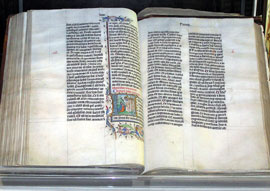
Image: The Malmesbury Bible (photo by Adrian Pingstone). Public Domain