
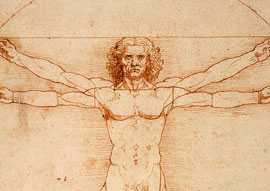
 In the first century of the Common Era, two contrasting views of the nature of the human person were abroad in the land where Christianity arose: the classical Hebrew and classical Greek understandings.
In the Hebrew view, man was a unit, and hope for life after death depended on the resurrection of the whole person. In the Greek view, man had a dual nature, and hope for life after death depended on the intrinsic immortality of the spiritual part of man. As H. Wheeler Robinson neatly put it, “The Hebrew idea of personality is that of an incarnated body, not (like the Greek) that of an incarnated soul.” 1
Biblical words like heart, soul, spirit, and flesh “simply present different aspects of the unity of the personality.” 2 The living soul is the total person.
Beginning with the conquests of Alexander the Great, the Greek view spread throughout the Mediterranean world and had a powerful influence even on Jewish thinking, not only in the Diaspora but also in Palestine. The result was that Judaism developed a variety of doctrines concerning the nature of man and of the afterlife, represented by the various Jewish denominations of the time.
The Sadducees, whose biblical canon was limited to the five books of Moses, believed in no life after death. The Lord’s blessing consisted solely of long life, prosperity, and many descendants. It was a sufficiently satisfactory doctrine for aristocrats who were well off in this life.
The Essenes seemed possibly to have believed in something like the transmigration of souls.
The Pharisees believed in the resurrection of the dead at the beginning of the Messianic Age, an idea that had most clearly been expressed in the twelfth chapter of the book of Daniel. But many Pharisees combined this hope with belief in an immortal spirit of man that is laminated to the body in life, separated from the body in death, and reunited with the body at the resurrection.
This last view, still common among both Jewish and Christian believers today, synthesizes the view of the Hebrew scriptures with that of classical Greek philosophy. Do we place our hope for life after death on a naturally immortal spirit—a spirit that survives independent of the body after death? Or does our hope rest on a miracle of God that raises a whole person, reanimating our bodies?
Logically, it would seem that these two views are incompatible, for if our personalities can survive consciously without bodies, what need do we have for a resurrection? Why again encumber blissful spirits with bodies if they can get along nicely without them? And which is responsible for sin, the spirit or the body? The rabbis wrestled with such questions.
How did Yeshua and his disciples deal with these issues? Yeshua clearly taught the resurrection of the dead, in contrast with the Sadducees. The whole man sins; the whole man is punished or rewarded; the whole man dies and is raised from the dead. In death, which Yeshua called a sleep, man is unconscious.
Matthew 22 narrates a dispute Yeshua had with various Jewish parties, among them the Sadducees. These presented him with a conundrum: If a woman marries seven brothers in succession, each one in turn dying, whose wife will she be in the resurrection? (Matthew 22:23–28.3) Yeshua prefaced his reply with a rebuke: “You are wrong, because you know neither the scriptures nor the power of God.” He supported the doctrine of the resurrection by citing Exodus 3:6, “I am the God of Abraham, and the God of Isaac, and the God of Jacob,” declaring that the Lord “is not God of the dead but of the living” (verses 29–33).
In the Gospel of John, Yeshua declares repeatedly that the resurrection life depends on faith in him: “I am the resurrection and the life; he who believes in me, though he die, yet shall he live” (John 11:25). Echoing the twelfth chapter of Daniel, Yeshua said that the hour is coming when all who are in the tombs will hear the voice of “the Son of man” (his self-designation) “and come forth, those who have done good, to the resurrection of life, and those who have done evil, to the resurrection of judgment” (John 5:25–29). But until then, death is a “sleep” (John 11:11).
On the other hand, if a person is destined for divine punishment, it is the whole being that is punished: “Do not fear those who kill the body but cannot kill the soul; rather, fear him who can destroy both soul and body in hell” (Matthew 10:28).
Such a saying exhibits some influence of Greek modes of expression, but the complete statement is clearly contrary to the Greek view. When Yeshua spoke in a figurative mode, the language sometimes approached something like dualistic expression, but in the end, the thought was thoroughly in line with the classical Hebrew understanding of man. Final destruction extends to the soul as well as the body.
The Greeks and those under their influence thought of the spirit as good and the fleshly body as bad. The rabbis typically held rather to a sort of ethical dualism: the human person was created with a good inclination (yetzer ha-tob) and an evil incli nation (yetzer ha-ra), the latter kept in check by the Torah. Again, Yeshua saw evil as something infecting the whole person, though humanity is not totally evil: “If you then, who are evil, know how to give good gifts to your children...” (Matthew 7:11). But the seat of evil is the heart. “For from within, out of the heart of a man, come evil thoughts: fornication, theft, murder, adultery, coveting, wickedness, deceit, licentiousness, envy, slander, pride, and foolishness. All these evil things come from within, and they defile a man” (Mark 7:20–23).
The disciples and apostles of Yeshua for the first few generations similarly preserved the classical Hebrew understanding of human nature, though they sometimes clothed it in metaphors drawn from Hellenistic language and modes of expression. They could speak of “body, soul, and spirit,” but only as aspects of the unitary person, not separable entities capable of independent conscious existence.
Thus Paul can pray, “May the God of peace himself sanctify you wholly; and may your spirit, soul, and body be kept sound and blameless at the coming of the Lord Jesus Christ” (1 Thessalonians 5:23). Paul’s hope was firmly anchored in his belief in the resurrection of the body. The classic example of his teaching on this subject is the fifteenth chapter of 1 Corinthians. In answer to the question, “How are the dead raised? With what kind of body do they come?” Paul replies, “What you sow does not come to life unless it dies. And what you sow is not the body, which is to be, but a bare kernel, perhaps of wheat or of some other grain. But God gives it a body as he has chosen, and to each kind of seed its own body. So it is with the resurrection of the dead. What is sown is perishable; what is raised is imperishable. We shall not all sleep, but we shall all be changed, in a moment, in the twinkling of an eye, at the last trumpet" (1 Corinthians 15:35–50). The resurrection body will be different from our present body, but there will be a recognizable continuity between them.
Paul insisted that sin and evil were the universal condition of all people: “All men, both Jews and Greeks, are under the power of sin” (Romans 3:9). This sinful condition somehow infected the whole human race by infecting the first man: “Sin came into the world through one man and death through sin” (Romans 5:12), for “the wages of sin is death, but the free gift of God is eternal life in Christ Jesus our Lord” (6:23). It is this malignancy that causes us to sin in spite of our best intentions (Romans 7:7–20).
The New Testament, nevertheless, insists that each person must take responsibility for his transgressions: “Let no one say when he is tempted, ‘I am tempted by God’; for God cannot be tempted with evil, and he himself tempts no one; but each person is tempted when he is lured and enticed by his own desire” (James 1:12-15).
So the Hebrew conception of humanity continued on in the New Testament, albeit clothed sometimes in Greek dress. Man is a unit, and if that unit dissolves, the result is death. He lives, dies, and lives again as one person; he sins and finds redemption as one unitary person—“body, soul, and spirit.”
1H. Wheeler Robinson, The Christian Doctrine of Man, 3rd ed. (Edinburgh: T. & T. Clark, 1958), p. 27.
2Ibid.
3All scriptural quotations in this article are taken from the Revised Standard Version.
Image: Vitruvian Man. Leonardo da Vinci. Public Domain