
For Flavius Josephus, the famous Jewish historian of the first century C.E., Daniel was the “greatest of the prophets,” for not only did he prophesy concerning future events, but he actually made known the time when these events would take place in history.1
Josephus’s sentiment for the prophet is reflected in the Jewish faith and literature of the time.2 The Jews of that period generally believed that they were living at the edge of the fulfillment of God’s eschatological promises. Rome, the fourth kingdom predicted in Daniel’s prophecies (chaps. 2 and 7), was the precursor to the Messiah’s coming.3 Thus, it is not surprising that the predictions of the book of Daniel have an important place in the writings of the New Testament. In this article, we will examine several important New Testament references to the book of Daniel.
Daniel and the Gospels
The Birth of Yeshua. The Gospel of Luke begins with the visit of the angel Gabriel to two pious, religious Jews—Zacharias the priest and Miriam, a woman of Davidic lineage. Gabriel’s message was that the comings of the promised Elijah, in the person of John the Baptist, and the Messiah, Yeshua, were imminent. Luke believes that these events are the fulfillment of the prophecies of Malachi (chaps. 3 and 4) and Daniel. Interestingly, Daniel is the only person in the Hebrew Bible to whom Gabriel appeared in order to bring understanding (Dan. 8, 10–12) and to whom he predicted the time of the Messiah’s coming (Dan. 9); thus, it is significant that Gabriel appears again to announce the birth of the Messiah.
Yeshua’s Public Ministry. Yeshua began His public ministry by proclaiming that “the time is fulfilled, and the kingdom of God is near” (Mark 1:15), a proclamation taken from Dan. 9:24–25.
The Son of Man. One of the most common titles applied to Yeshua in the New Testament is “the Son of Man” (e.g., Matt. 8:20; 9:6). This title, inspired by the eschatological figure of the Son of Man found in Dan. 7:13–14, appears to have been a key term for the widespread Jewish messianic expectations of the time.4
The Destruction of Jerusalem
As Yeshua looked to the future of His people, He directly applied Daniel’s prophecies to the coming destruction of Jerusalem and the Temple and the intense suffering that would follow. In Matt 24:15–21, He referred to the “Abomination of the Desolation” (i.e., the Roman power) that would stand in the “Holy Place” (i.e., Jerusalem) in the near future—events predicted by Daniel (e.g., 7:7-9; 8:9–14; 9:26–27).
Although the power of Rome would utterly destroy Jerusalem, causing enormous distress and suffering, this would not be the end. As also predicted by Daniel (7:9–14, 26–27), the final victory belongs to the “Son of Man” and to God’s people (Matt. 24:30–25:46).
Yeshua’s Death and Resurrection. In its chronological presentation, Yeshua’s ministry is correlated with the last prophetic week of the 70-week prophecy of Daniel 9. In the middle of this week (or three and a half years), as predicted in Dan. 9:26, the Messiah would be cut off. The Messiah’s death is referred to in Dan. 9:26–27 as the confirmation of God’s covenant with “many” in the middle of the last week.
Danielic themes mark the Gospel’s presentation of Yeshua’s last Passover with His disciples. When He said, “This is my blood of the covenant, which is poured out for many for forgiveness of sins” (Matt 26:28), He is referring directly to Dan. 9:24, 26–27—the only place in the Hebrew Bible where the ideas of “forgiveness of sins,” “death of the Messiah,” and “covenant” with "many are quoted together.5
Daniel and the Epistle to the Hebrews
The Epistle to the Hebrews also elaborates on the book of Daniel, speaking about the “covenant” and its “confirmation” in “an appointed time” through “the death of the Messiah” for the benefit of “many” (Heb. 9:17–28). These elements were important to the Jewish messianic expectations of the time, as one can observe in the emphasis on the words “covenant” and “many” among the Essenes,6 and in the notion of the death of the Messiah and forgiveness of sins that appears in some Rabbinic literature.7
Daniel and the Book of Revelation
The New Testament closes with the book of Revelation, which shares a direct correlation with the book of Daniel. The imagery of Revelation resounds like Daniel’s apocalyptic message.
The Son of Man. At the beginning of his vision of the heavenly realities, John sees the same being who was depicted in Dan. 8:15–16 and 10:5–6. This heavenly being is like “a son of man” (Rev. 1:13–15). John recognizes this being as Yeshua.
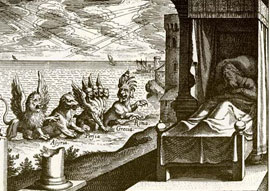
The Visions of Revelation. The visions of Revelation are intrinsically interwoven with those of Daniel. The vision of the throne of God and the scene of judgment in Rev. 4–5 recall the parallel scene in Dan 7. The evil power described as a beast in Rev. 13 is reflected in the four beasts and the little horn of Dan. 7. The description of the glorious coming of the Son of Man in Rev. 14:14–16 and 19:11–21 recalls scenes of the judgment described in Dan. 7:11–14. Thus, Daniel provides the key to understanding Revelation.
Conclusion
The book of Daniel was held in high regard by the writers and characters of the New Testament, from Yeshua’s proclamations to the apocalyptic imagery of the book of Revelation. The messages of God that inspired and troubled the prophet not only guided the community of the past, but they continue to guide the community of today.
1.Josephus, The Antiquities of the Jews, X. 11, 7.
2.See, e.g., 1 Maccabees 1:54; 1 Enoch, 83-93; The Sybilline Oracles, Book 4; The Testament of Levi, 16-18.
3.See the eschatological expectation and computation of the time in R. T. Beckwith, “Daniel 9 and the Date of Messiah’s Coming in Essene, Hellenistic, Pharisaic, Zealot and Early Christians’ Computation,” Revue de Qumran 40/10 (1981): 521-542.
4.See 1 Enoch, 37-71. Cf. O. Michel, “The Son of Man,” The New International Dictionary of New Testament Theology, ed. Colin Brown (Grand Rapids: Zondervan, 1978), 3:614-615.
5.Indirectly, it also evokes Isa 53, where three of these elements are present together, but the word “covenant” does not appear, although one could consider it to be implicit.
6.See, e.g., The Damascus Document, XV, 5-9. See also 1QS VI, 13-15.
7.E.g., The Babylonian Talmud, Sanhedrin 98b; Midrash Pesiqtah Rabbati, Pisqa 37; and Moshe Hadarshan’s Midrash Bereshit Rabbati, Genesis 24:67.
Reinaldo Siqueira Professor of Hebrew Scriptures
Image: Engraving of Daniel's vision of the four beasts in chapter 7 by Matthäus Merian, 1630. Public Domain