
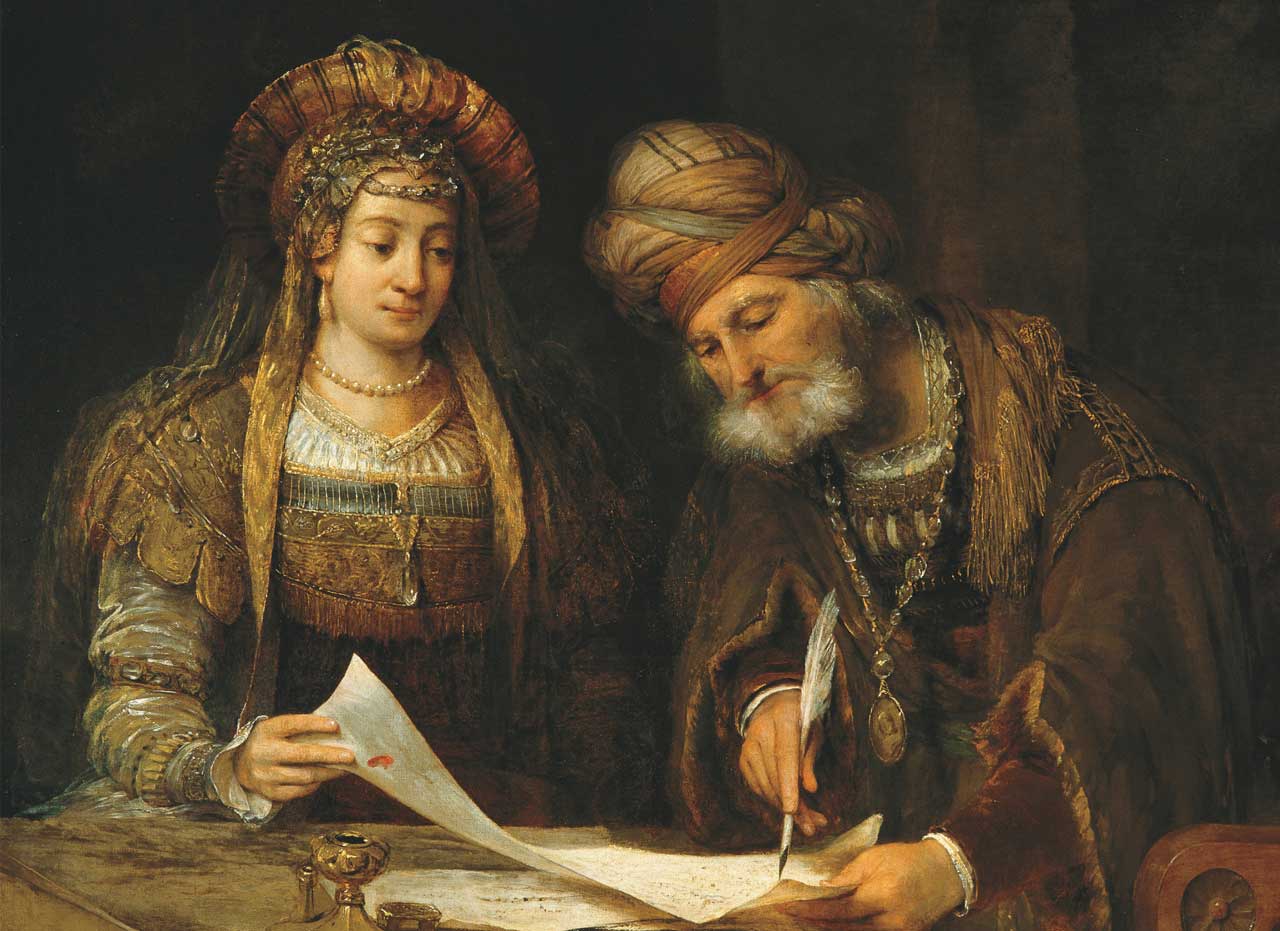
 Set in the land of the Persian city of Shushan, located in modern-day Iran, the story of Purim (“Festival of Lots,” as derived from the ancient Persian language) depicts the Book of Esther and Haman’s plot to exterminate all the Jewish people living in the Persian Empire.
Without recounting the entire Book of Esther, the Jews fought back against Haman’s plans and celebrated their victory on the 14th of Adar (or the 15th of Adar in Jerusalem and other cities walled during the days of Joshua based on texts in Esther 9:18, or the 14th day of Adar II in the case of Jewish leap years)—the day they were set to be killed. While Purim is celebrated during Adar II in the years in which it is applicable, 14 Adar I is still considered a festive, special day known as Purim Katan (“small Purim”).
The day before Purim, the 13th of Adar, is designated as Ta’anit Esther (the Fast of Esther); the fast honors Esther and the sacrifice of the Jews of Shushan as they fasted for three days prior to Esther approaching the King as depicted in Esther 4:16.
Purim originated in the second century, though many Jews did not formally celebrate or make note of the holiday until many centuries later. In the present time, with antisemitism raging throughout the world, Haman continues to be symbolic of any oppression of the Jewish people, with the Purim story being used to describe Jewish victory over various oppressions. The Purim holiday has subsequently become a joyful, festive community or congregation-wide celebration of the Jewish people prevailing over Haman’s death decree and the bravery of Esther, the Jewish wife of King Ahasuerus (who began ruling over Persia around 486 BC) who had concealed her Jewish faith from her husband.
Interestingly, the Book of Esther is one of the two books of the Bible, the other being the Song of Songs, which does not mention God. Numerous scholars have speculated on the omission of God being referenced in the Book of Esther and His role in the miracle of delivering the Jewish people from near-certain death.
Some commentators speculate that perhaps the Book of Esther refers to a time when God was “hidden” from the world, though we know from scripture that the Lord never leaves or forsakes us. Hence the name “lots” suggests that perhaps the Jews were simply “lucky,” though we know God had His hand in the deliverance even if it was behind the scenes or even He was seemingly absent from the depiction of the story. Without God, the fate of the Jewish people in the Persian Empire could have been very different.
There are four mitzvot related to Purim:
- One mitzvot is to read the Book of Esther (the Megillah or Megillot Esther), which recounts the miracle of Purim, ideally both in the morning and evening, using a special rendition of the Book of Esther exclusively dedicated to Purim.
- It is considered customary to be charitable to at least two needy individuals (matanot l'evyonim, “gifts to the poor"). Matanot l’evyonim could consist of any combination of money, food, beverage, clothing, or other necessities; Shulchan Arukh specifies that gifts should be bestowed upon two needy people. Often, matanot l’evyonim will include a machazit hashekel (half shekel) of money, which is symbolic of the half shekel donated by all Jewish people in ancient times for temple upkeep during the Hebrew month of Adar.
- Traditionally, one will share ready-to-eat food with at least one friend, though two friends are considered praiseworthy. Whether one shares with one or two friends, the situation is considered more ideal if the basket is sent through a third person.
This tradition is referred to as mishloach manot or shalach manos—Purim baskets—which are often exchanged among family members or friends. The Purim baskets usually contain various sweets, homemade foods, snack foods, sweets, fruits, wine, grape juice, or hamantaschen, but must contain at least two different types of food according to the principles of Shulchan Arukh (Code of Jewish Laws).
Mishloach manot is based on the concept of Esther 9:22, which describes Purim “as days of feasting and merrymaking, and as an occasion for sending gifts to one another and presents to the poor.” The gifts to one or two friends are considered to be representative of goodwill, friendship, and unity among the Jewish people.
- It is customary to participate in a festive meal, which often includes wine. The Babylonian sage Rava mentioned in Megillah 7b of the Talmud, “A person is obligated to become livasumei (intoxicated) on Purim until he does not know the difference between ‘cursed is Haman’ and ‘blessed is Mordechai.’”
Besides being a day of merrymaking, tzedakah (charity), volunteering in local soup kitchens or food pantries, conducting canned food drives, and otherwise giving to those in need, Purim is also often associated with social justice initiatives.
Some view Purim as an opportunity to reflect on deeper, more troubling messages in the Book of Esther related to Vashti and Esther that some view as related to issues of their gender. Vashti’s dignity was compromised for refusing to dance at the King’s drinking party, and Esther's was compromised as she feared for her life approaching the King, and both women are seen by some as having limited control over their bodies and livelihoods.
Some Jewish communities may therefore use Purim as an opportunity to collect old cell phones from those affected by domestic violence and donate these phones to the National Coalition Against Domestic Violence. This non-profit will then distribute the deactivated phones to those in domestic violence situations so that they can call 911 for other emergency assistance without the phone being traceable by an abusive partner or individual. Other Jewish people may use Purim as a chance to contribute to other causes they deem to be associated with women’s empowerment.
Many will traditionally, outside the scope of the mitzvot, celebrate Purim by dressing up in costumes (a tradition possibly dating back to Italy in the 14th century), wearing colorful, glittery, and/or sequined masks, participating in local parades or carnivals, using groggers (noisemakers) to drown out the name of Haman when it comes up during the reading of the Megillah, or performing plays (shpiels, the Yiddish word for plays, which could be depicting any variety of topics and themes of one’s own choosing) while wearing festive costumes.
The costumes loosely reflect the different apparel worn by characters in the Book of Esther, such as Mordechai’s sackcloth and the royal garments of Ahasuerus and Esther. It also ties into the idea of concealing one’s identity, as Esther kept her Jewish identity under wraps.
Purim is sometimes compared to a Jewish Halloween or Jewish Mardi Gras, perhaps because of the masks, the partygoing, the sometimes excessive alcohol consumption, and the costumes, but neither of these comparisons is entirely accurate. Besides the obvious message of the triumphant deliverance of the Jewish people from the death decree of Haman, Purim is a holiday that tackles other themes as well: God’s role in our lives, antisemitism, women’s roles, and other bold or courageous actions. Purim, despite common misconceptions, is not merely a Jewish rendition of Halloween or Mardi Gras, despite the costumes, masks, alcohol consumption, and party scene.
One of the foods most frequently associated with Purim is the hamantaschen (a German word meaning “Haman’s pockets”), which would be a triangular pastry (symbolic of the three-cornered hat that Haman is believed to have worn) filled with apricots, prunes, raspberry, chocolate, poppy seeds, apple, jams, Nutella, or various fruits. Some believe that by consuming the triangular pastry, they are consuming the memory of Haman. In some more mature audiences, some believe the triangular pastries are symbolic of fertility, especially if the pastries are filled with a red filling such as strawberry, raspberry, or cherry, coupled with Purim being a springtime holiday. Other Jewish communities may bake ma’amouls, which refer to cookies that are most often stuffed with either dates or nuts.
Jewish people will often recite or sing Shoshanot Yaakov (“The Rose of Jacob”) after a congregation, small group, or family reads the Megillah. “Rose” refers to the city of Shushan, and “Rose of Jacob” refers to the entire Jewish population of the city of Shushan. The Shehecheyanu blessing may also be said during Purim celebrations.
Customary greetings include Chag Purim sameach (“happy Purim holiday”), Purim sameach (“happy Purim"), or Chag Sameach (a generic “happy holiday” that transcends Purim and applies to many Jewish holidays).
As some fun facts show, Joseph Stalin had plans to murder the Jewish people of the Soviet Union but fascinatingly died on Purim in the spring of 1953. Later in 1990, Saddam Hussein invaded Kuwait, launching Operation Desert Storm, and in the process, he also launched some missiles toward Israel. After the United States responded by attacking Iraqi forces, all missiles being fired toward Israel ceased, and all hostilities involving Israel were suspended on Purim.
Purim overall celebrates a revival of fortune for the Jewish people who were saved from Haman’s plot to "destroy, kill, and annihilate all the Jews, young and old, infants and women, in a single day” thanks to Queen Esther and her cousin Morechai. This divine blessing bestowed upon the Jewish people, regardless of whether they acknowledge God’s involvement, seems to inspire periodic spiritual revivals among the Jewish people.
May we not only learn from the history of Purim but also look toward the future, where echoes of Esther’s courage and the joy of communal festivities continue to resonate through the generations.
Add comment